Summary
In a lot of growing fintechs, compliance runs on spreadsheets, shared inboxes and rules buried in application code. That works for a while. Then a new obligation arrives, or an auditor asks how a decision was made six months ago, and it becomes clear how much depends on a few people remembering things.
Fintech Den™ helps compliance teams move that work into a system they control. Rules are written as configuration that compliance officers can read and approve, rather than code only engineers can change. Reports and suspicious activity drafts are built from live data. Every change, decision and approval is recorded.
We're a new company, and we don't yet have a long client list. So rather than make big claims, this paper sets out how we'd approach the problem, the regulatory dates we'd plan around, how we handle your data, and a first project small enough for you to judge our work properly.
Data protection is usually the first thing UK and EU buyers check, so we'll say it up front: we comply with the UK GDPR and the EU GDPR, and we're registered with the UK Information Commissioner's Office. The GDPR section below explains what that means for your project, from where your data is hosted to how we'd tell you about a breach.
The problem
The trouble usually starts with where the rules live. A transaction limit or a screening threshold gets hard-coded by an engineer, often under deadline pressure. When the rule needs to change, someone has to find it, change it and release new software, and the compliance team has no easy way to show what changed, when, or who approved it.
Reporting tends to be the next pain point. Monthly returns, safeguarding figures and suspicious activity reports get pieced together by hand from several systems, which is slow and easy to get wrong. When an auditor, examiner or partner bank asks to reconstruct a past decision, it can take days.
Over time, written policies and what the systems actually do drift apart. And because every new regulation seems to need another hire, compliance costs grow faster than the business. Experienced compliance staff are also hard to find.
How we would approach it
We'd start by mapping your obligations and finding out where each rule and report actually lives today. Then we'd move the most painful process first, rather than trying to change everything at once.
The system we build usually has three parts:
| Part | What it does | What we'd aim for |
|---|---|---|
| Rule engine | Compliance rules held as versioned configuration that officers can read, change and approve | Rule changes that don't wait for a software release |
| Reporting | Audit trails, suspicious activity report drafts and regulator-ready exports built from live data | Less manual assembly and fewer errors at month-end |
| Policy management | One place for policies, with role-based access so people can only do what their role allows | Policies and system behaviour that match, with evidence to show it |
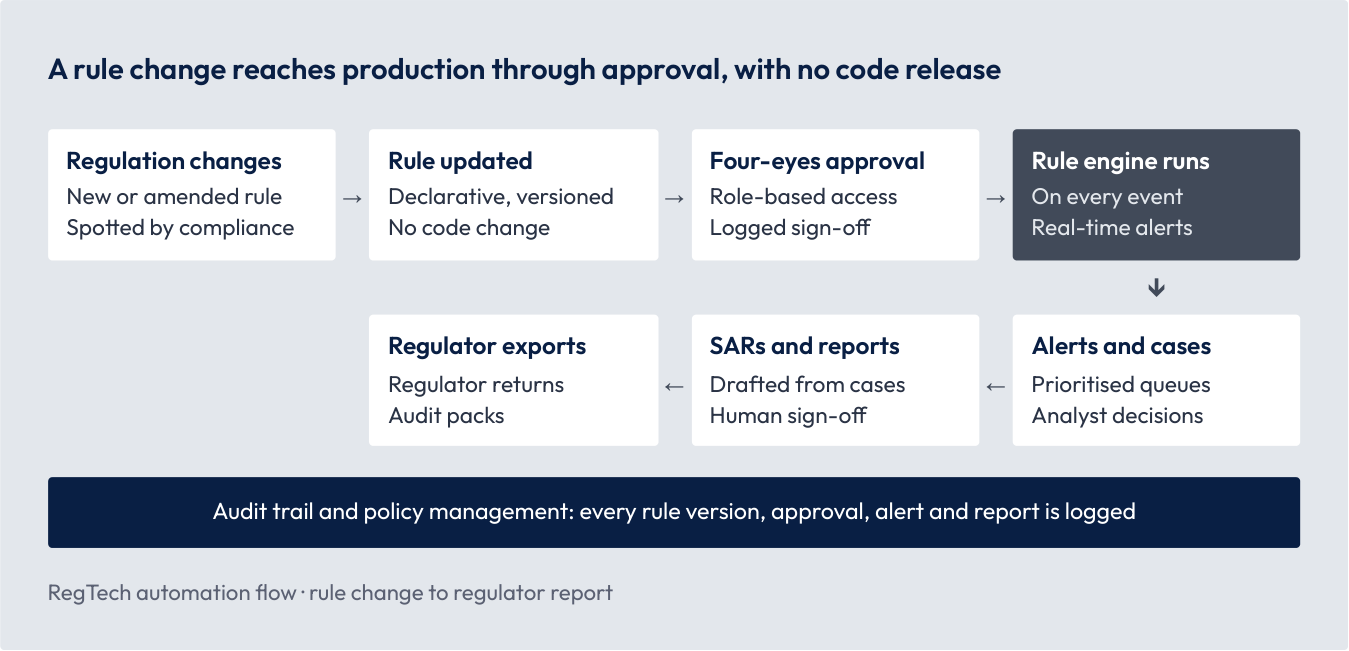
The diagram follows a single rule change. Compliance updates the rule, a second person approves it, and the engine applies it to every event. Alerts go to analysts, and reports are drafted from their cases. Every step is logged.
The system drafts and flags; your officers decide and sign. We connect to your existing core, payments and onboarding systems through APIs, so you don't need to replace them to get started.
The regulatory calendar, 2025 to 2028
If you operate in more than one of these markets, new obligations arrive roughly every quarter. These are the dates we'd plan around. Some are already in force and some are still expected, so treat this as a starting point for discussion with your compliance team, not legal advice.
| Date | Market | Change | What it means in practice |
|---|---|---|---|
| 17 Jan 2025 | EU | Digital Operational Resilience Act (DORA) applies | Incident logs, a register of ICT suppliers and resilience evidence |
| 9 Oct 2025 | EU | Instant Payments Regulation: euro-area firms must send SEPA Instant and offer Verification of Payee | Real-time screening and payee-check records |
| Date | Market | Change | What it means in practice |
|---|---|---|---|
| 20 Mar 2026 | US | Nacha fraud monitoring, Phase 1 for larger participants | Documented, risk-based ACH monitoring |
| 7 May 2026 | UK | FCA safeguarding rules: daily checks, monthly returns, annual audit | Automated reconciliation and return data |
| 22 Jun 2026 | US | Nacha fraud monitoring, Phase 2, with volume thresholds removed | The same controls for every participant |
| 2 Aug 2026 | EU | AI Act transparency obligations apply | Records showing customers know when they deal with AI |
| Dec 2026 (expected) | UK | Consultation on changes to APP scam reimbursement | Rules ready to update once changes are confirmed |
| 10 Jul 2027 | EU | EU Anti-Money Laundering Regulation applies | Customer due diligence and monitoring rules reviewed |
| 2 Dec 2027 | EU | AI Act high-risk obligations, including credit scoring | Model records, logging and human-oversight evidence |
| Around 2028 (expected) | EU | PSD3 and the Payment Services Regulation | Updates to fraud monitoring, authentication and open-banking rules |
One to keep an eye on: the US open-banking rule under Section 1033 was finalised in 2024 but is on hold and being reconsidered. Holding rules as configuration means you can prepare for it without hard-coding an outcome that might change.
UK and EU GDPR compliance
A compliance team will rightly hold us to a high standard here. We comply with the UK GDPR, alongside the Data Protection Act 2018, and with the EU GDPR. On client projects where we handle personal data, you're the controller and we act as your processor. Here's what that means in practice.
| Area | What we do |
|---|---|
| Data processing agreement | We sign one with every client, covering everything Article 28 of the UK and EU GDPR requires. We act only on your documented instructions, and everyone on your project is bound by confidentiality. Our standard agreement is ready for your legal team to review. |
| Collecting less | Systems collect only the personal data they need. By default we build and test with synthetic or masked data, not live customer records. |
| Retention | Retention periods can be held as rules alongside your other compliance rules, so records are kept for as long as the law requires and no longer. |
| Where data lives | Production systems run in your own cloud account, in the UK or EU region you choose. |
| Area | What we do |
|---|---|
| Access and transfers | Any access to real personal data is agreed with you first, limited to named people, logged, and removed when the task is done. If access ever involves a transfer outside the UK or EU, it's covered by the EU standard contractual clauses or the UK international data transfer agreement. Both are ready to sign. |
| Security | Encryption in transit and at rest, least-privilege access, logging, and code review on every change. |
| Sub-processors | We tell you which sub-processors we use, and add new ones only with your prior authorisation. |
| People's rights | We help you respond when people ask to see, correct or delete their data. |
| Breaches | If we become aware of a personal data breach affecting your data, we tell you without undue delay, so you can meet the 72-hour deadline for reporting it to the ICO or your EU supervisory authority. |
| Assessments and audits | We support your data protection impact assessments, give you the information you need to show compliance, and allow audits. |
| End of the work | We return or delete your personal data, whichever you choose. |
Where we stand on registrations and certifications. We'd rather be precise than impressive.
| Item | Where it stands |
|---|---|
| ICO (UK) | Registered with the Information Commissioner's Office. |
| EU to UK data flows | The EU recognises UK data protection law as adequate. The European Commission renewed that decision in December 2025, and it runs until December 2031. |
For EU firms under DORA. If you're an EU financial entity, our DORA information sheet gives you what you need to record us in your register of ICT third-party providers: our company details, the services we provide, where data is processed and the subcontractors we use. We'll also work through the DORA contract terms with your team.
How we work
Since we can't yet show you years of past projects, we'd like to show you our process instead, in writing, before you commit.
The people you'll work with. You deal directly with our leadership. There's no account manager in between.
| Role | What they look after on your project |
|---|---|
| Chief Executive Officer | The relationship, scope, security and data protection, and fit with your compliance priorities |
| Chief Technology Officer | Rule engine and data design, technology choices, technical sign-off, and on some projects the relationship and scope |
| Head of Engineering | The delivery plan, system connections, testing and releases |
| Head of Visual Design | The rule editor, case queues, dashboards and report layouts your officers use every day |
Company and working hours. Fintech Den™ is a trading name of ROMBI PIXEL LTD, a UK company registered in England and Wales (no. 15947340) with its registered office in Bury St. Edmunds. We run on Central European Time (CET), so our working day overlaps with business hours across the UK and EU. For US clients, our afternoon overlaps with the East Coast morning, and we schedule calls in that window.
The practical side. We quote and invoice in euros, US dollars or pounds, whichever suits your finance team, and EU clients can pay by SEPA transfer to our euro account. Proposals spell out scope, milestones, payment points and VAT treatment, and payments are tied to milestones you can check. Our master services agreement is ready for your legal team, and we're open to discussing governing law and other terms.
Habits you can hold us to. We send a written summary within one working day of every call. You get a short written update every week and a demo every two weeks. Risks go in a shared log as soon as we spot them, and nothing changes scope without your written agreement.
What the first 90 days usually look like. We'd automate one process and run it alongside your current way of working before anyone relies on it.
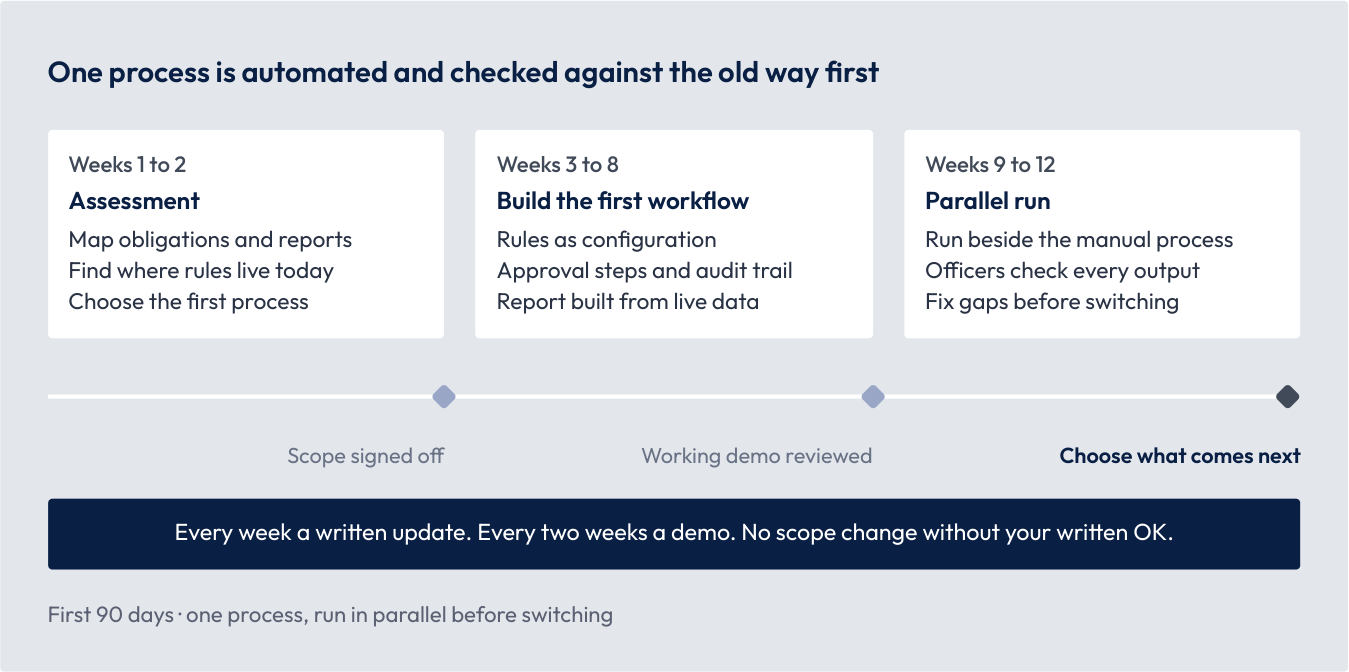
You can stop at any checkpoint and keep everything we've produced so far.
Starting a conversation
The first call is mostly us listening. We'll probably ask about:
- Which compliance tasks take up the most of your team's time.
- Which regulators, licences and partner banks you answer to, and in which markets.
- What your last audit or regulatory review raised.
- Where your rules live today: in code, in vendor tools or in spreadsheets.
- Which systems hold the data your reports depend on.
If it looks like we can help, we'll suggest one of these as a first step. Timings are typical, not fixed, and we'll confirm them in a written proposal.
| Option | Typical length | What you'd receive |
|---|---|---|
| Compliance assessment | About 2 weeks | A process map, a list of your obligations, a few quick wins and a fixed-scope plan |
| First automated process | About 3 months | One process, such as monthly safeguarding reporting or ACH monitoring rules, automated and run in parallel with the manual version |
| Wider roll-out | Agreed together | More processes moved across over time, with handover and optional ongoing support |
If it doesn't look like a good fit, we'll tell you, and where we can, we'll point you to someone better placed.
Before the call, we're happy to send our trust pack: our data processing agreement and the EU and UK transfer clauses, plus the DORA information sheet if you're an EU financial firm. We are working towards IASME Cyber Assurance and the NCSC-backed Cyber Essentials certification.
To arrange a call, email contact@fintechden.com. We'll reply within one working day.
Common questions
Which compliance work can be automated, and what stays with people?
The system drafts and flags; your officers decide and sign. Compliance rules are held as versioned configuration that officers can read, change and approve. Audit trails, suspicious activity report drafts and regulator-ready exports are built from live data.
Do we have to replace our existing systems to automate compliance?
No. The system connects to your existing core, payments and onboarding systems through APIs, so you don't need to replace them to get started.
How long does it take to automate a first compliance process?
A compliance assessment takes about 2 weeks. A first automated process takes about 3 months, for example monthly safeguarding reporting or ACH monitoring rules, and it runs in parallel with the manual version before you rely on it.
Sources
- ECB: Instant Payments Regulation
- Nacha: Fraud Monitoring Phase 2
- FCA: changes to payment safeguarding rules
- Messaging Architects: what took effect on 2 August 2026
- Bratby Law: APP fraud reimbursement evaluation
- Gibson Dunn: EU AI Act Omnibus agreement
- Open Banking Tracker: PSD3 and PSR readiness
- Open Banking Tracker: Section 1033 status
- Hunton: European Commission renews UK adequacy decisions
- ICO: contracts between controllers and processors
- GDPR Article 33: notifying a personal data breach
More white papers
- AI Governance Retrofits: Making Existing Models Explainable and Auditable: Audit the fraud and credit models you already run, and give your risk officers a live view of how they decide.
- The AI-Powered Risk Engine: Explainable fraud and credit risk scoring that your analysts and regulators can follow.
- Custom API Integration: Connecting Old and New Systems Safely: One secured layer between your products, partners, banks and legacy systems.