Summary
Fraud teams and credit teams are being asked to do two things at once. Catch more of the losses that slip through today, and show regulators exactly how they do it. This paper explains how Fintech Den™ would help with both.
We design and build risk tooling around three pieces: machine-learning risk scoring that sits alongside the rules your team already trusts, fraud detection that looks across transactions and accounts, and Monte-Carlo stress testing for your portfolio. Each piece can be built on its own.
We're a new company, and we'd rather be straight with you about that. We don't have a long client list to point to yet. What we can offer is a senior team, a careful process, and a first project small enough that you can judge our work before committing to anything bigger. The rest of this paper sets out the problem as we see it, how we'd approach it, the rules that apply in the US, UK and EU, and how we handle your data.
Data protection is usually the first thing UK and EU buyers check, so we'll say it up front: we comply with the UK GDPR and the EU GDPR, and we're registered with the UK Information Commissioner's Office. The GDPR section below explains what that means for your project, from where your data is hosted to how we'd tell you about a breach.
The problem
Much of today's fraud doesn't look like fraud at the moment it happens. A customer is talked into sending money to a scammer, a mule account receives it, and every login and authentication check passes. Rule sets written a few years ago for card fraud tend to miss this, and when they're tightened to catch more, they start blocking good customers too.
At the same time, more of the cost is landing on the firm. In the UK, sending and receiving payment firms now share the cost of reimbursing scam victims. In the US, ACH rules now cover payments authorised under false pretences. Credit decisions are under similar pressure: lenders are expected to explain declines, check for bias and keep a record of how their models change over time.
None of this is easy for a growing fintech. It needs data engineers, data scientists and risk specialists working together, and those people are hard to hire.
How we would approach it
We don't start with a product to sell you. We start by looking at where your losses actually come from, what data you hold, and what your regulator or partner bank has been asking about. The design follows from that.
In most cases the build has three parts:
| Part | What it does | What we'd aim for |
|---|---|---|
| Risk scoring | Scores events in real time using a blend of machine-learning models and rules your team controls | More consistent decisions, each with a reason a person can read |
| Fraud detection | Looks for unusual patterns across transactions and accounts, including device and behavioural signals | Fewer losses without blocking more good customers |
| Portfolio stress testing | Runs Monte-Carlo scenarios on your loan book under different economic assumptions | Scenario results you can share with regulators and investors |
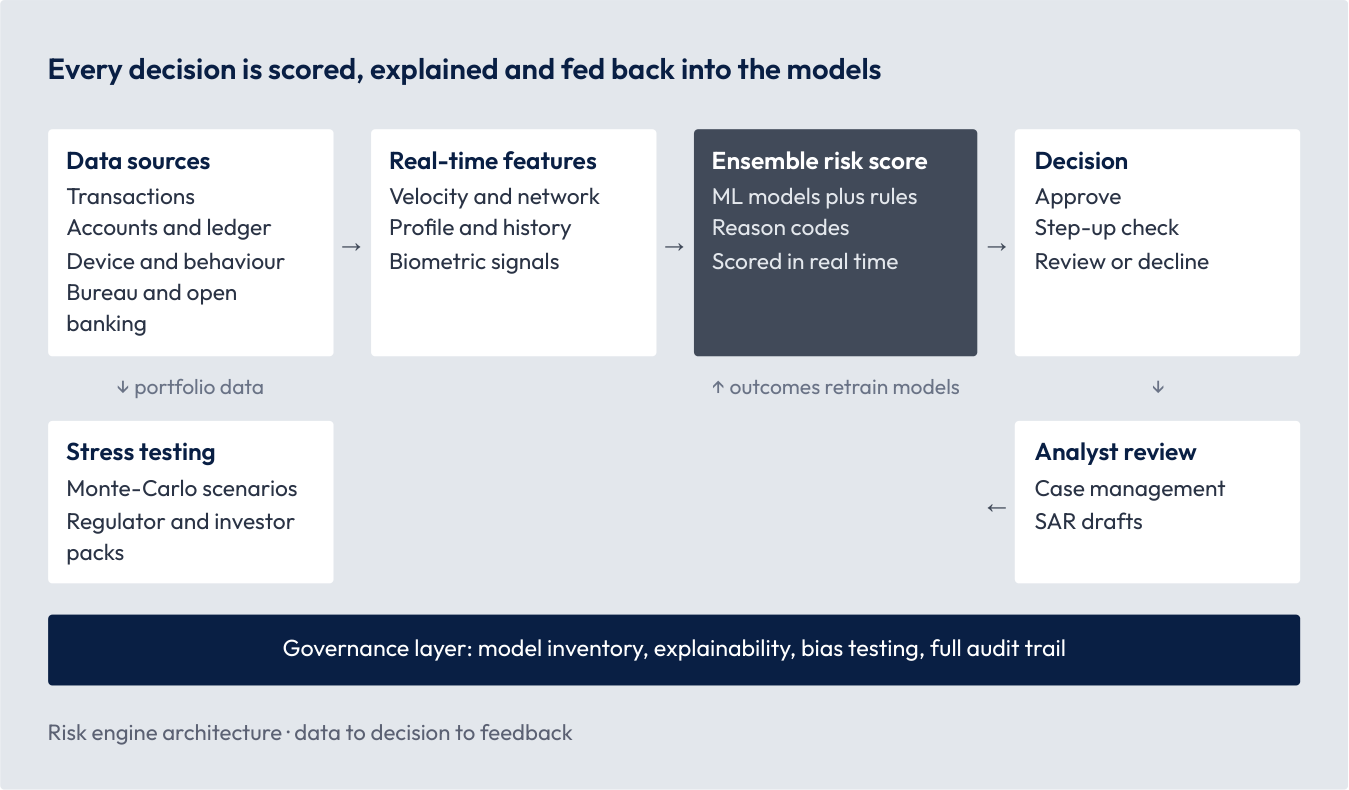
The diagram shows the loop we'd build: data comes in, gets scored and decided, analysts review the hard cases, and their decisions go back into training the models. A governance layer underneath keeps a record of every model version and decision.
A few principles guide us. Every score should come with a reason an analyst or examiner can understand. People make the final call on difficult cases. Your compliance team keeps control of hard rules, and models handle the patterns rules tend to miss. And everything runs in your own cloud account, in the region you choose.
We won't promise a percentage drop in fraud before we've seen your data. During discovery we agree how success will be measured, and we report against that honestly.
Regulation in the US, UK and EU
The rules differ by market, but they're heading the same way: firms are expected to monitor actively, explain their decisions and keep good records. Here's a short summary of what prospects in each market most often need to think about. Your own compliance team and lawyers will know your position best, and this isn't legal advice.
| Market | Rule | Where it stands (October 2026) | What it means for the build |
|---|---|---|---|
| US | Nacha fraud monitoring rules for ACH, including payments made under false pretences | Phase 1 from 20 March 2026; Phase 2, covering everyone regardless of volume, from 22 June 2026 | Documented, risk-based monitoring of ACH payments in and out |
| US | Fair lending, adverse-action notices and partner banks' model risk expectations | In force | Clear reasons for declines, bias testing and a model change log |
| UK | APP scam reimbursement, shared by sending and receiving firms up to £85,000 per claim | In force since 7 October 2024; first evaluation published July 2026, consultation expected December 2026 | Checks on both outgoing payments and incoming mule activity |
| UK | FCA Consumer Duty | In force | Avoid unfairly blocking or delaying good customers |
| EU | AI Act: credit scoring is classed as high-risk AI | Obligations now apply from 2 December 2027, after the Digital Omnibus delay | Risk management, logging, human oversight and documentation from the start |
| EU | PSD3 and the Payment Services Regulation | Final texts published April 2026; most rules expected to apply around 2028 | Monitoring that can be extended as the new rules arrive |
UK and EU GDPR compliance
Fraud and credit systems handle some of the most sensitive personal data a firm holds, so this is often the first thing a UK or EU buyer asks about. We comply with the UK GDPR, alongside the Data Protection Act 2018, and with the EU GDPR. On client projects where we handle personal data, you're the controller and we act as your processor. Here's what that means in practice.
| Area | What we do |
|---|---|
| Data processing agreement | We sign one with every client, covering everything Article 28 of the UK and EU GDPR requires. We act only on your documented instructions, and everyone on your project is bound by confidentiality. Our standard agreement is ready for your legal team to review. |
| Collecting less | Systems collect only the personal data they need. By default we build and test with synthetic or masked data, not live customer records. |
| Where data lives | Production systems run in your own cloud account, in the UK or EU region you choose. |
| Access and transfers | Any access to real personal data is agreed with you first, limited to named people, logged, and removed when the task is done. If access ever involves a transfer outside the UK or EU, it's covered by the EU standard contractual clauses or the UK international data transfer agreement. Both are ready to sign. |
| Area | What we do |
|---|---|
| Security | Encryption in transit and at rest, least-privilege access, logging, and code review on every change. |
| Sub-processors | We tell you which sub-processors we use, and add new ones only with your prior authorisation. |
| Automated decisions | When a fraud or credit decision made by automated means alone significantly affects someone, UK and EU rules set conditions and require safeguards: people must be told, and be able to challenge the decision and have a person review it. Every decision in our designs carries a readable reason and a route to analyst review. |
| People's rights | We help you respond when people ask to see, correct or delete their data. |
| Breaches | If we become aware of a personal data breach affecting your data, we tell you without undue delay, so you can meet the 72-hour deadline for reporting it to the ICO or your EU supervisory authority. |
| Assessments and audits | We support your data protection impact assessments, which fraud scoring and credit decisioning often need. We also give you the information you need to show compliance, and allow audits. |
| End of the work | We return or delete your personal data, whichever you choose. |
Where we stand on registrations and certifications. We'd rather be precise than impressive.
| Item | Where it stands |
|---|---|
| ICO (UK) | Registered with the Information Commissioner's Office. |
| EU to UK data flows | The EU recognises UK data protection law as adequate. The European Commission renewed that decision in December 2025, and it runs until December 2031. |
For EU firms under DORA. If you're an EU financial entity, our DORA information sheet gives you what you need to record us in your register of ICT third-party providers: our company details, the services we provide, where data is processed and the subcontractors we use. We'll also work through the DORA contract terms with your team.
How we work
Since we can't yet show you years of past projects, we'd like to show you our process instead, in writing, before you commit.
The people you'll work with. You deal directly with our leadership. There's no account manager in between.
| Role | What they look after on your project |
|---|---|
| Chief Executive Officer | The relationship, scope, security and data protection, and making sure the work serves your business and regulatory goals |
| Chief Technology Officer | Architecture and modelling approach, technology choices, model quality and explainability, technical risk, final technical sign-off, and on some projects the relationship and scope |
| Head of Engineering | The delivery plan, code quality, testing and releases |
| Head of Visual Design | Analyst screens, dashboards and reports |
Company and working hours. Fintech Den™ is a trading name of ROMBI PIXEL LTD, a UK company registered in England and Wales (no. 15947340) with its registered office in Bury St. Edmunds. We run on Central European Time (CET), so our working day overlaps with business hours across the UK and EU. For US clients, our afternoon overlaps with the East Coast morning, and we schedule calls in that window.
The practical side. We quote and invoice in euros, US dollars or pounds, whichever suits your finance team, and EU clients can pay by SEPA transfer to our euro account. Proposals spell out scope, milestones, payment points and VAT treatment, and payments are tied to milestones you can check. Our master services agreement is ready for your legal team, and we're open to discussing governing law and other terms.
Habits you can hold us to. We send a written summary within one working day of every call. You get a short written update every week and a demo every two weeks. Risks go in a shared log as soon as we spot them, and nothing changes scope without your written agreement.
What the first 90 days usually look like. This is a typical plan for a first project; we'd tailor it to you during discovery.
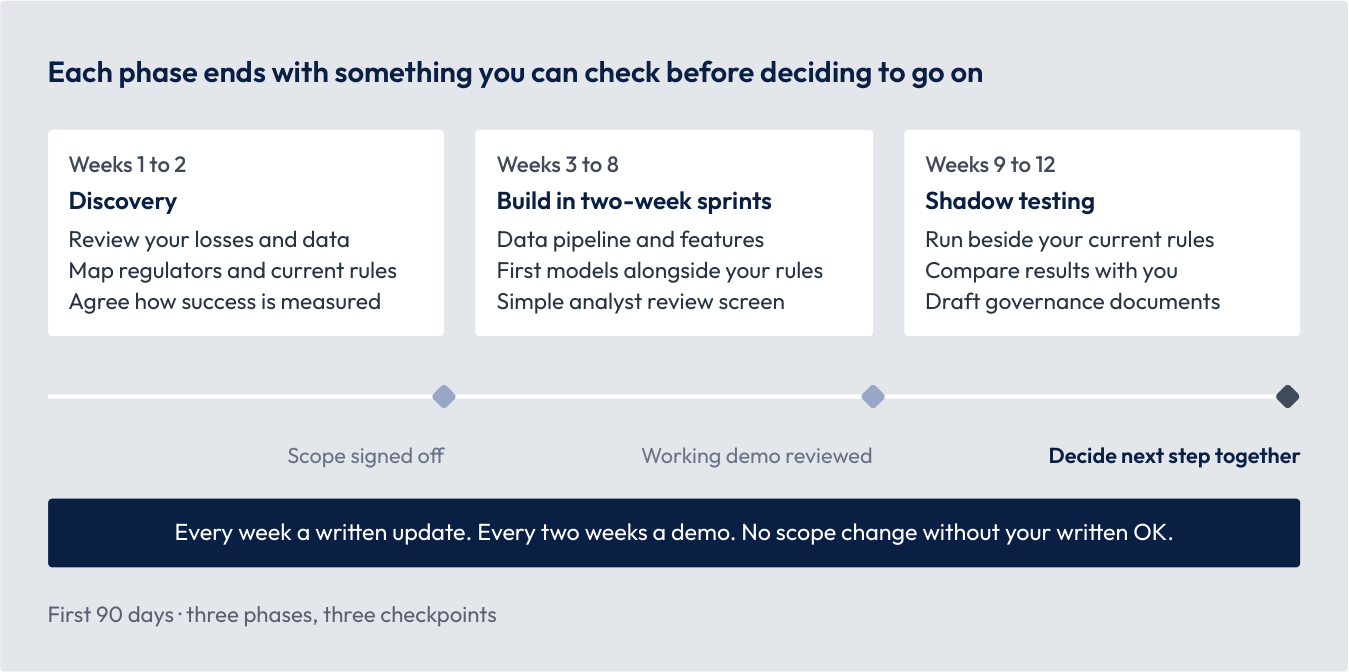
You can stop at any checkpoint, and you'll keep everything we've produced up to that point.
Starting a conversation
The first call is mostly us listening. We'll probably ask about:
- Where your biggest losses come from today, whether that's card fraud, scams, account takeover or credit defaults.
- What your current tools decide, and where your analysts spend most of their time.
- Which regulators and partner banks oversee you, and what they've asked for recently.
- What labelled history you have, such as confirmed fraud, chargebacks or defaults.
- Where your data has to be hosted.
If it looks like we can help, we'll suggest one of these as a first step. Timings are typical, not fixed, and we'll confirm them in a written proposal.
| Option | Typical length | What you'd receive |
|---|---|---|
| Discovery sprint | About 2 weeks | A review of your losses and data, a map of the rules that apply, a proposed design and a fixed-scope plan |
| Proof of value | About 3 months | One use case built and run in shadow mode beside your current rules, with an honest side-by-side report |
| Full build | Agreed together | A production system, governance documents and handover, with optional ongoing support |
If it doesn't look like a good fit, we'll tell you, and where we can, we'll point you to someone better placed.
Before the call, we're happy to send our trust pack: our data processing agreement and the EU and UK transfer clauses, plus the DORA information sheet if you're an EU financial firm. We are working towards IASME Cyber Assurance and the NCSC-backed Cyber Essentials certification.
To arrange a call, email contact@fintechden.com. We'll reply within one working day.
Common questions
Can machine-learning fraud and credit scores be explained to a regulator?
Yes, when explanation is designed in from the start. In the approach this paper describes, every score comes with a reason an analyst or examiner can read, people make the final call on difficult cases, and your compliance team keeps control of the hard rules. A governance layer keeps a record of every model version and decision.
How long does a first risk-engine project take?
A discovery sprint takes about 2 weeks. A proof of value takes about 3 months: one use case is built and run in shadow mode beside your current rules, with a side-by-side report. A full build is agreed together after that.
How much will a risk engine reduce our fraud losses?
We won't promise a percentage before we've seen your data. During discovery we agree how success will be measured, and we report against that measure.
Sources
- Nacha: Fraud Monitoring Phase 2
- Bratby Law: APP fraud reimbursement evaluation
- Gibson Dunn: EU AI Act Omnibus agreement
- Open Banking Tracker: PSD3 and PSR readiness
- Hunton: European Commission renews UK adequacy decisions
- ICO: contracts between controllers and processors
- GDPR Article 33: notifying a personal data breach
- Herbert Smith Freehills Kramer: UK data protection reform goes live (February 2026)
More white papers
- AI Governance Retrofits: Making Existing Models Explainable and Auditable: Audit the fraud and credit models you already run, and give your risk officers a live view of how they decide.
- Automating Compliance Work Without Losing Control: Rules your officers can read, change and approve, with every step logged.
- Fintech Den Accelerators: Reusable Building Blocks for Faster Launches: Tested, reusable components for onboarding, ledgers and payments, so you pay mainly for the work that is specific to you.