Summary
Banks and fintechs want new products live in months, not years, but every custom build starts by writing the same foundations again: onboarding with KYC checks, a ledger, a payments gateway, an admin console. That repeated work makes projects slower and more expensive than they need to be.
Fintech Den™ is building a library of accelerators: reusable components that we develop once, test properly and license to clients, so that a project only pays in full for the configuration and integration that are specific to it. The first components are onboarding with KYC and AML checks, a double-entry ledger and a payments gateway.
We want to be clear about where we are. These components are being built now, from our own reference builds and the work we do for clients. We won't claim a fixed percentage of any project is already done. Before you commit, we'll show you exactly what exists, what has been tested, and what would be new for you.
Data protection is usually the first thing UK and EU buyers check, so we'll say it up front: we comply with the UK GDPR and the EU GDPR, and we're registered with the UK Information Commissioner's Office. The GDPR section below explains what that means for your project, from where your data is hosted to how we'd tell you about a breach.
The problem
Long deployment times hurt both sides. Banks find that even simple digital products take a year to reach customers, and fintechs burn cash while foundations are rebuilt. Buying a full platform can be quick, but it often means accepting someone else's roadmap and pricing for years.
Custom builds have the opposite problem. They fit well, but the client pays for every line, including the parts that are the same in every project. Those parts also carry the most regulatory weight, so they need the most testing.
What most teams want is in between: proven building blocks they can trust, with the freedom to change them and the right to leave.
How we would approach it
We'd start with a fit check: a demo of the components that exist, compared with your requirements, and a fixed quote for the gap. Only the configuration and integration that are specific to you are priced as custom work. If a component isn't ready for your use case, we'll tell you, and price it as a build instead.
In most cases the build has three parts:
| Part | What it does | What we'd aim for |
|---|---|---|
| Onboarding accelerator | Customer onboarding flows with KYC and AML checks, connected to the identity-verification providers you choose | A tested starting point instead of a blank page |
| Ledger accelerator | A double-entry ledger with accounts, balances, postings and reconciliation reports | A sound record of every balance from day one |
| Payments accelerator | A payments gateway with routing, payee checks and a status API, ready to connect to your rails | Payment rails added through configuration rather than new code |
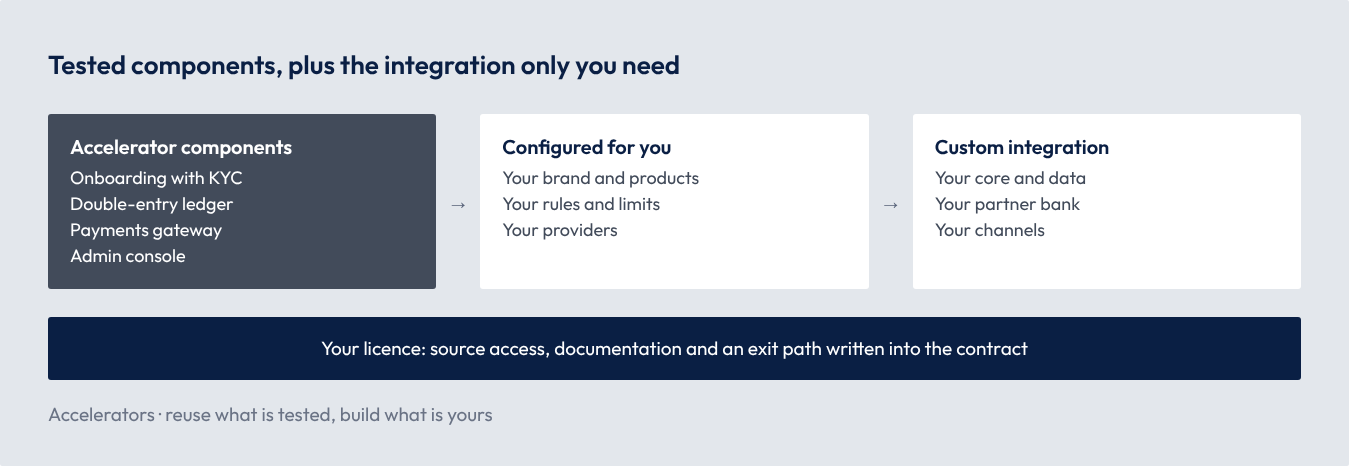
The diagram shows how a project is put together. The components on the left are the same for every client and are tested once. Configuration in the middle adapts them to your products and rules. Integration on the right connects them to your systems, and that is where most of the project effort goes.
Licensing is designed for regulated firms. Your contract gives you access to the source code and documentation, audit rights, and a clear exit path, so the components can pass the outsourcing and resilience reviews your supervisors or partner banks will run.
What regulators and partner banks will ask about licensed components
Licensed software in a bank or regulated fintech is treated as a third-party arrangement, so it needs the same contract terms and evidence as any critical supplier. This is a summary for discussion, not legal advice.
| Market | Rule | Where it stands (November 2026) | What it means for the build |
|---|---|---|---|
| EU | Digital Operational Resilience Act (DORA) | Applies since 17 January 2025 | Contract terms, an exit plan and a register entry for each licensed component |
| EU | EBA Guidelines on outsourcing arrangements | In force | Audit and access rights, source-code access and termination rights in the licence |
| UK | FCA operational resilience rules: important business services and impact tolerances | Firms had to be able to stay within their impact tolerances by 31 March 2025 | Components mapped to your important business services and tested with you |
| UK | FCA safeguarding rules for payment and e-money firms: daily checks, monthly returns, annual audits | In force since 7 May 2026 | Safeguarding reports available from the ledger accelerator |
UK and EU GDPR compliance
Licensed components run in your environment and process your customers' data, so the data protection terms must be as clear as for a custom build. We comply with the UK GDPR, alongside the Data Protection Act 2018, and with the EU GDPR. On client projects where we handle personal data, you're the controller and we act as your processor. Here's what that means in practice.
| Area | What we do |
|---|---|
| Data processing agreement | We sign one with every client, covering everything Article 28 of the UK and EU GDPR requires. We act only on your documented instructions, and everyone on your project is bound by confidentiality. Our standard agreement is ready for your legal team to review. |
| Collecting less | Systems collect only the personal data they need. By default we build and test with synthetic or masked data, not live customer records. |
| Where data lives | Production systems run in your own cloud account, in the UK or EU region you choose. |
| Licensed components | Accelerators run in your own cloud account. We don't receive your customers' data through the licence, and any support access is agreed with you first and logged. |
| Area | What we do |
|---|---|
| Access and transfers | Any access to real personal data is agreed with you first, limited to named people, logged, and removed when the task is done. If access ever involves a transfer outside the UK or EU, it's covered by the EU standard contractual clauses or the UK international data transfer agreement. Both are ready to sign. |
| Security | Encryption in transit and at rest, least-privilege access, logging, and code review on every change. |
| Sub-processors | We tell you which sub-processors we use, and add new ones only with your prior authorisation. |
| People's rights | We help you respond when people ask to see, correct or delete their data. |
| Breaches | If we become aware of a personal data breach affecting your data, we tell you without undue delay, so you can meet the 72-hour deadline for reporting it to the ICO or your EU supervisory authority. |
| Assessments and audits | We support your data protection impact assessments, give you the information you need to show compliance, and allow audits. |
| End of the work | We return or delete your personal data, whichever you choose. |
Where we stand on registrations and certifications. We'd rather be precise than impressive.
| Item | Where it stands |
|---|---|
| ICO (UK) | Registered with the Information Commissioner's Office. |
| EU to UK data flows | The EU recognises UK data protection law as adequate. The European Commission renewed that decision in December 2025, and it runs until December 2031. |
For EU firms under DORA. If you're an EU financial entity, our DORA information sheet gives you what you need to record us in your register of ICT third-party providers: our company details, the services we provide, where data is processed and the subcontractors we use. We'll also work through the DORA contract terms with your team.
How we work
Since we can't yet show you years of past projects, we'd like to show you our process instead, in writing, before you commit.
The people you'll work with. You deal directly with our leadership. There's no account manager in between.
| Role | What they look after on your project |
|---|---|
| Chief Executive Officer | The relationship, scope, licensing terms, security and data protection |
| Chief Technology Officer | Component architecture, the gap analysis, technical risk, final technical sign-off, and on some projects the relationship and scope |
| Head of Engineering | Configuration, integrations, testing and releases |
| Head of Visual Design | Customer-facing screens, brand configuration and the admin console |
Company and working hours. Fintech Den™ is a trading name of ROMBI PIXEL LTD, a UK company registered in England and Wales (no. 15947340) with its registered office in Bury St. Edmunds. We run on Central European Time (CET), so our working day overlaps with business hours across the UK and EU. For US clients, our afternoon overlaps with the East Coast morning, and we schedule calls in that window.
The practical side. We quote and invoice in euros, US dollars or pounds, whichever suits your finance team, and EU clients can pay by SEPA transfer to our euro account. Proposals spell out scope, milestones, payment points and VAT treatment, and payments are tied to milestones you can check. Our master services agreement is ready for your legal team, and we're open to discussing governing law and other terms.
Habits you can hold us to. We send a written summary within one working day of every call. You get a short written update every week and a demo every two weeks. Risks go in a shared log as soon as we spot them, and nothing changes scope without your written agreement.
What the first 90 days usually look like. We'd confirm the fit before you commit, then configure and integrate the components you need.
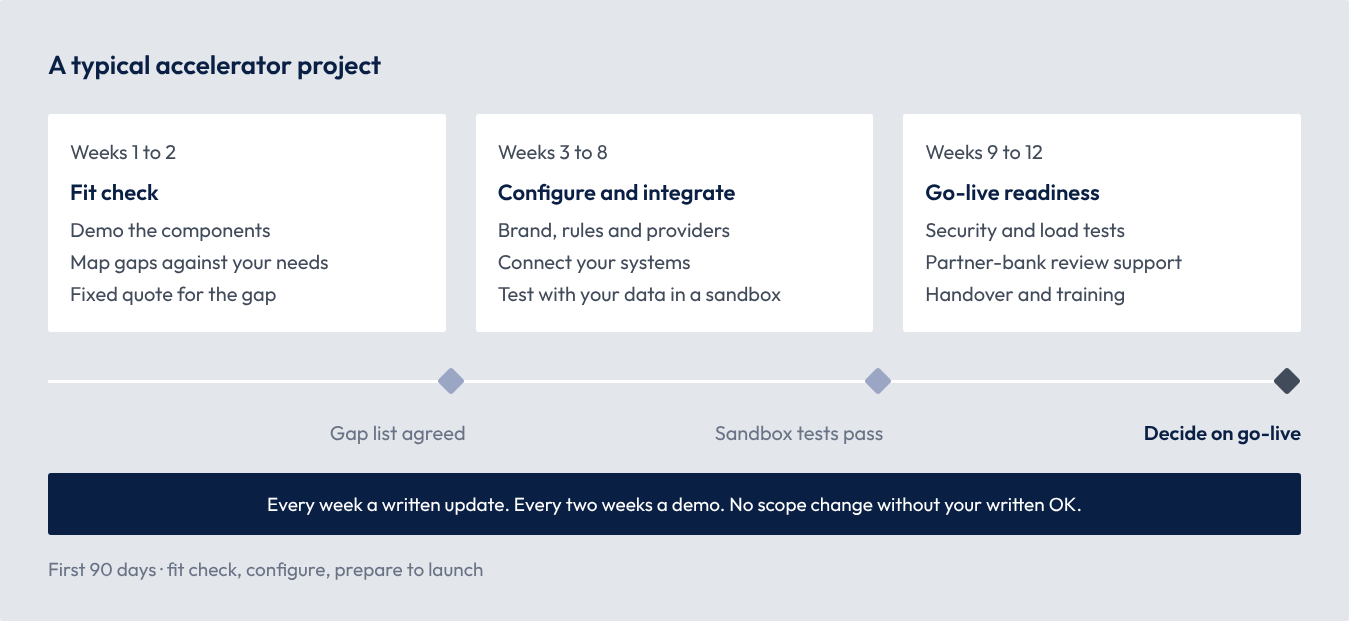
You can stop at any checkpoint and keep everything we've produced so far. If you stop before licensing, you keep the gap analysis and the quote.
Starting a conversation
The first call is mostly us listening. We'll probably ask about:
- Which product you want to launch, and by when.
- Which parts you've already built, bought or licensed.
- Your licensing route and partner banks, and what they require from suppliers.
- How much control you need over the source code.
- Where your data has to be hosted.
If it looks like we can help, we'll suggest one of these as a first step. Timings are typical, not fixed, and we'll confirm them in a written proposal.
| Option | Typical length | What you'd receive |
|---|---|---|
| Fit check | About 2 weeks | A demo of the components, a gap analysis against your requirements and a fixed quote |
| Accelerator project | About 3 months | The components you need configured, integrated and tested in your environment |
| Licence and support | Agreed together | A licence with source access and an exit path, with optional updates and support |
If it doesn't look like a good fit, we'll tell you, and where we can, we'll point you to someone better placed.
Before the call, we're happy to send our trust pack: our data processing agreement and the EU and UK transfer clauses, plus the DORA information sheet if you're an EU financial firm. We are working towards IASME Cyber Assurance and the NCSC-backed Cyber Essentials certification.
To arrange a call, email contact@fintechden.com. We'll reply within one working day.
Common questions
What are Fintech Den Accelerators?
Reusable components for onboarding, ledgers and payments that we develop once, test and license to clients, so a project pays in full only for the configuration and integration that are specific to it. The components are being built now; it is not yet a finished library.
Do we get the source code, and can we leave?
Yes. Your contract gives you access to the source code and documentation, audit rights and a clear exit path.
How long does an accelerator project take, and how is it priced?
A fit check takes about 2 weeks and ends with a gap analysis against your requirements and a fixed quote. An accelerator project takes about 3 months. Only the configuration and integration specific to you are priced as custom work.
Sources
- ESAs: DORA registers of information and critical ICT providers
- EBA: Guidelines on outsourcing arrangements
- FCA: operational resilience
- FCA: changes to payment safeguarding rules
- Hunton: European Commission renews UK adequacy decisions
- ICO: contracts between controllers and processors
- GDPR Article 33: notifying a personal data breach
More white papers
- Building a Challenger Bank: A Realistic Path to Launch: A modular core, one ledger and an honest timeline from first conversation to launch.
- Payments Orchestration: Bringing Your Payment Rails Under One Roof: Checks first, smart routing across rails, and reconciliation that posts to your ledger.
- The AI-Powered Risk Engine: Explainable fraud and credit risk scoring that your analysts and regulators can follow.